These days my main job consists of playing a grumpy old man who has to be re-educated about the joy of Christmas. I know, it doesn’t sound like much of a stretch. I would debate that, as I think I enjoy the Christmas season, but , as with many things, in my own way. I have a tree, ornaments and other holiday type displays, which I put up and enjoy, depending on where I am and what I am doing during the November / December months. They may not be your Happy Holidays, but they are mine…
…but I digress.
Part of the challenge of my “Scrooge-ing” is the position I place myself in, 2-ish hours a show, 8 or 9 times a week. I am affecting a hunched over posture, which gives me more of an old, decrepit look, as well as takes away from my 6’1” plus height. What it also does is place stress on my shoulders, neck and head. I’m getting stiffness, soreness and an occasional slight headache. My attempt at a solution?
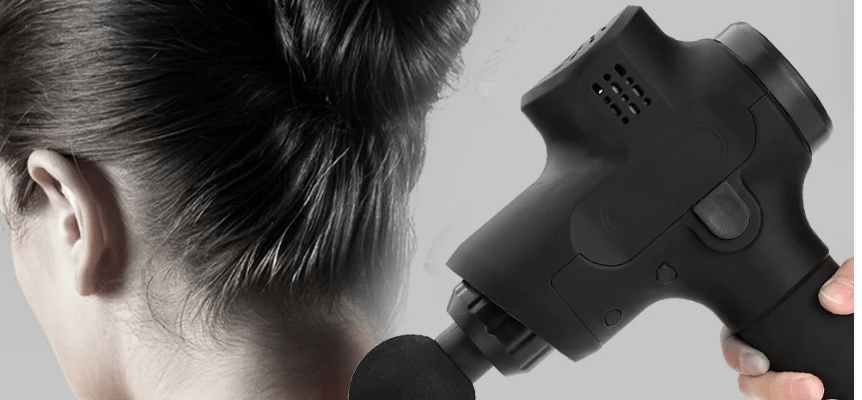
Vibration massage, also known by the brand name. Theragun.
They’ve been around for few years, and are all the rage among pro athletes, gym rats and anyone else who regularly pushes their body somewhere near it’s limits. But the basic idea goes back a little further. The application of manual vibration to the human body therapeutically has been known for centuries. Massage, of which vibration has always been an essential part, was known to ancient Greeks and Romans, Chinese and Slavs; in the 5th century B.C. Herodicus compelled his patients to have their body rubbed, as he firmly believed in the efficacy of massage. Other advocates of massage application were Plato, Socrates, and Hippocrates. In the middle of the 19th century, therapists constructed mechanical motion devices for treating neuralgia. Inventors also constructed and used mechanical apparatuses for massage, which could perform vibrating, shaking, rolling, percussion, compression, and friction.
The inventor of the massage gun as we know it is Dr Jason Wersland, who is a chiropractor. He is the founder and creator of the Theragun massage gun.He invented the it after a motorcycle accident in 2007 that left him with intense pain and atrophy. With that, he explored percussive therapy to help deal with his pain as he could not find any product on the market that could help him manage his pain.
How does it work?
When the massage gun is placed on your muscles and turned on, the attachments vibrate or “percuss” at a high frequency and low amplitude of movement. Advocates claim that this promotes recovery from workouts and improves overall performance while reducing muscle soreness. As the inclusion of the term “advocates claim” would imply, there is not extensive research to support the effectiveness of this form of vibro-massage therapy. “You can use a massage gun whenever you’re looking to relieve some muscle tension, but it may be especially beneficial to use after a workout to promote recovery with reduced muscle soreness,” says Leada Malek, DPT, SCS, a sports physical therapist in San Francisco who’s board-certified through the American Board of Physical Therapy Specialists. “Massage can reduce tension in muscles and impact flexibility, reducing muscle stiffness, increasing blood flow, and decreasing muscle soreness,”
So there’s a DPT, a SCS and an “American Board of Physical Therapy Specialists.” All in one sentence.
How do you use it?
To use the gun effectively, find an area on your body that feels tight, and start by moving the gun over the bulk of the muscle. “Add pressure as tolerated, but not too aggressively,” Malek says. (Typically there’s a button or switch on the gun to increase pressure.) Stay in one spot for up to 15 seconds or sweep an area for 2 minutes. The devices usually have many settings so you can customize the power and speed to suit your wants and needs. Most devices come with a few attachments that are ideal for different muscle sizes. This lets you tailor the massage even more.
Benefits
Get around better. Repetitive movements, trauma, or even sleeping in a single position can make your body stiff or sore because your fascia tightens up. This may affect how you move. A quick massage gun session can loosen up fascia so your muscles move better.
Recover after exercise. Gliding the massage gun over muscles may help your body recover more quickly or effectively after a workout.
Feel better after an injury. You can also try a massage gun on a muscle injury. But you may want to go gentler than you would without an injury.
Where not to use a massage gun
Where you use the massage gun is critical. Running it over certain spots can be painful. If you glide the massage gun over bones, nerves, and joints, it can hurt. You shouldn’t put it on skin that’s been sunburned or wounded. Massage guns are only made to go on muscles and fascia.
You may not want to use one if you’re on blood thinners because this could cause bruising. You might also want to avoid a massage gun if you have diabetes, deep vein thrombosis, blood clotting disorders, epilepsy, osteoporosis, or another musculoskeletal condition. Ask your doctor about using a massage gun if you’re pregnant.
I just got mine yesterday. I’m going to do at least 2 sessions a day on my shoulders and neck. I used it this morning. It’s an interesting feeling, I’ll give it that. We’ll see how it goes and I’ll give you my feedback after a few weeks. As with many other therapies and trends I’ve tried since we started this in 2018, my goal is to go in with an open mind. And hopefully come out a pain free head. We’ll see.
Talk later,
Bob
 practicallywell.net